

Transforming Business Processes with Dispatcher Stratus Forms

From employee onboarding and HR requests to compliance documentation, customer intake forms, service requests and approvals, forms are often the starting point of critical business processes. Unfortunately, many organizations still rely on email attachments, paper forms, shared spreadsheets, or disconnected systems to collect and manage information.
With Dispatcher Stratus Forms, organizations don't have to choose between supporting existing paper-based processes and embracing digital transformation. Dispatcher Stratus enables both, helping businesses digitize workflows where it makes sense while continuing to support paper-based interactions as they modernize over time.
More Than Data Collection
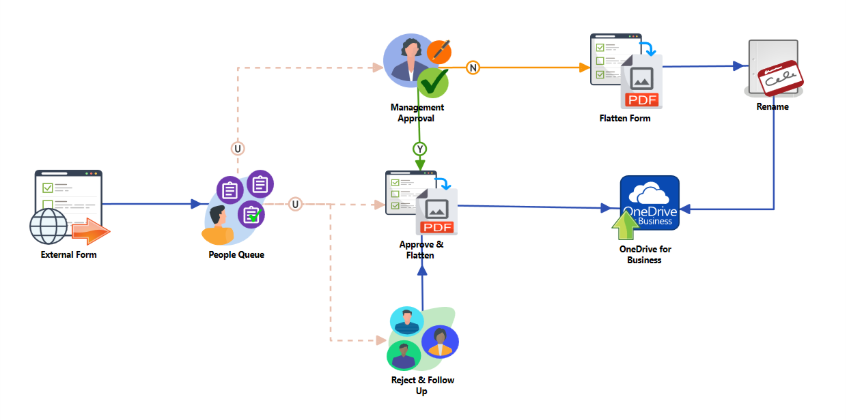
Forms are often viewed simply as a way to collect information, but in reality, they are the front door to many business workflows. With Dispatcher Stratus, organizations can build custom forms that are directly integrated into automated workflows. So instead of collecting information and manually routing it to the next person, forms can immediately trigger business processes, assign work, initiate approvals, and provide visibility throughout the entire lifecycle of the request.
Designed for Business Users
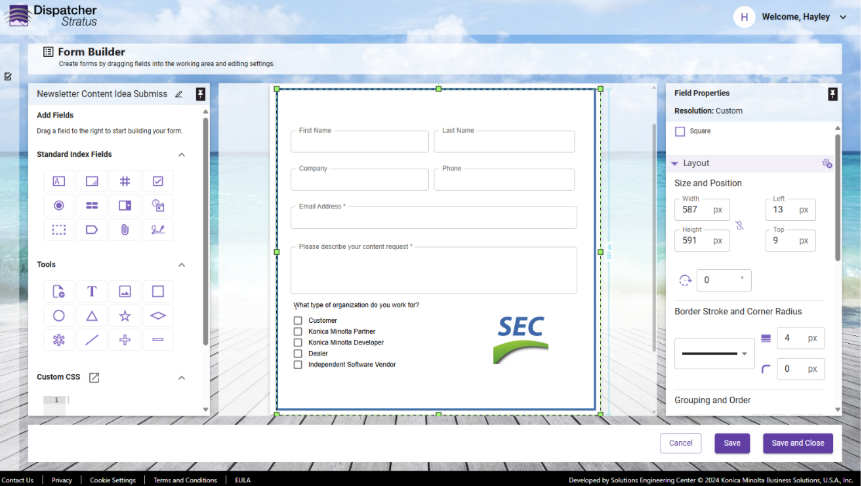
One of the key advantages of Dispatcher Stratus Forms is the intuitive Form Builder experience. Using a drag-and-drop interface, administrators can quickly create forms that align with specific business requirements without requiring custom development. Fields, validation rules, layouts, and user prompts can all be customized to ensure users provide the information needed to complete the process efficiently. This allows organizations to rapidly deploy new solutions while maintaining consistency across departments and workflows.
Supporting a Wide Range of Use Cases
Because forms can be embedded into virtually any workflow, they can be adapted to support a variety of operational needs, including:
- Employee onboarding requests
- IT service requests
- Purchase and procurement approvals
- Customer intake processes
- Document submission and collection
- Compliance and audit workflows
- Incident and issue reporting
- Project request management
By standardizing how information is collected, organizations can improve data quality while reducing manual effort.
Reaching Users Wherever They Work
Today's business processes often extend beyond a single department or office location. Dispatcher Stratus supports both forms for authenticated Dispatcher Stratus users and forms for individuals who do not have a Dispatcher Stratus account. This allows organizations to gather information from employees, customers, vendors, and partners. External forms can also be embedded into websites or business applications, creating a seamless experience for users, while ensuring submitted information is securely incorporated into existing workflows. This flexibility helps organizations collect information where it naturally originates rather than forcing users into a separate system.
Automation Beyond Submission
The real value of a form isn't just about collecting data - it's in what happens next. Once a form is submitted, Dispatcher Stratus can automatically route information to the appropriate users, queues, or workflow stages. Notifications can be generated, approvals can be initiated, and tasks can be assigned without manual intervention. Using the Archive Node, submitted documents and related records can be automatically stored in designated repositories for retention, compliance, and easy retrieval. The MFP In node extends workflows to multifunction printers (MFPs), allowing documents to be printed, scanned, captured, or distributed as part of an end-to-end automated process. This eliminates many of the bottlenecks that commonly occur when requests are managed through email or paper-based processes.
Improving Visibility and Accountability
Forms also help organizations establish greater visibility into business operations. Instead of information being scattered across inboxes and shared drives, requests become trackable items within Dispatcher Stratus. Process owners can monitor status, identify bottlenecks, review historical activity, and ensure requests are moving through established business processes. This creates greater accountability while providing the transparency needed to continuously improve operations.
More Than Just Forms
A form is often the first step in a business process. Dispatcher Stratus Forms help ensure it's not the last. By combining customizable forms with automated workflows, organizations can collect information from virtually any source and move it through the appropriate business process with minimal manual intervention. The result is greater consistency, improved visibility, and less time spent managing requests through email, spreadsheets, and paper-based processes.
Interested in learning how Dispatcher Stratus Forms can support your organization's workflows? Contact your Konica Minolta representative for more information.
